Underpowered amplifiers struggled across five zones, voice reinforcement was limited, microphones were scarce, and the processing chain could not support the sophistication the room needed.
A Q-SYS design white paper
Challenge
accepted.
A deliberately ambitious redesign of the Classic Room audio-visual (AV) system—and a deliberate experiment in using artificial intelligence as a primary development partner.
The assignment
One room.
Many lives.
The Classic Room at Waukesha County Technical College is a fine-dining room, culinary classroom, lunch-service venue, community-event space, competition viewing gallery, and occasional District Board meeting room. Few spaces are asked to wear so many hats.
The system needed to shift its capabilities to meet the needs of its users—not force users to reshape their events around the limits of the technology.
Culinary instructionLunch serviceCommunity eventsCompetition viewingBoard meetings
The inherited system
Capable once.
Confining now.
The aging system had become a collection of rigid limits and unreliable parts. It was centered on an Extron Digital Twisted Pair (DTP) Crosspoint that coupled switching, routing, audio processing, and control inside one box with little room for the Classic Room to evolve.
High-definition sources were tied to fixed transmitter and receiver paths instead of being freely routable to the display needed for the event.
Only three zone configurations existed. Changing the room often meant shutting the system down, restarting it in another preset, and relying on touchscreens that no longer worked consistently.
The response
A platform,
not a preset.
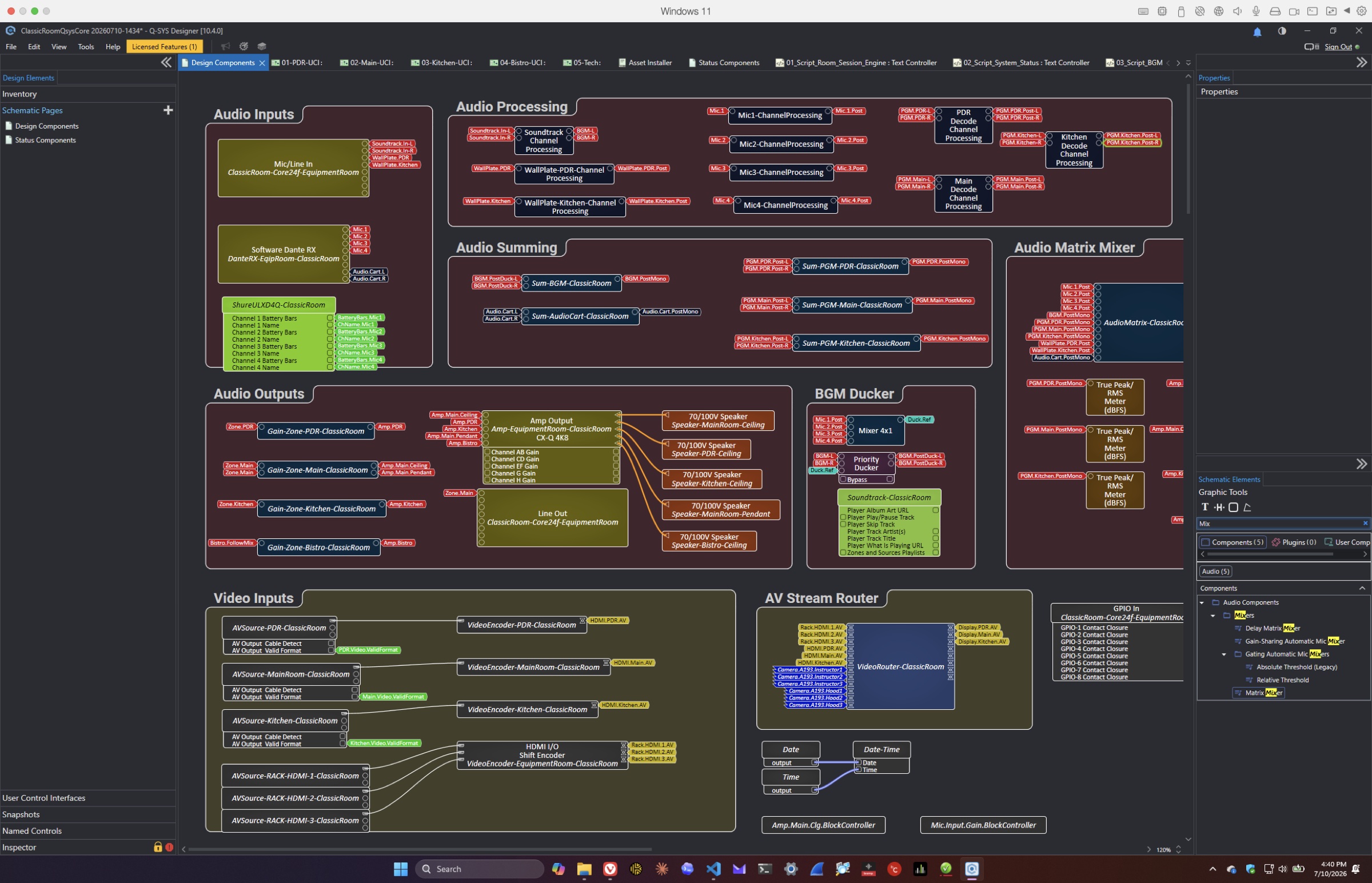
QSC's Q-SYS was selected as a unified audio, video, and control platform—a programmable foundation that could become the system the room needed now and continue changing with it later.
Core processing
The Q-SYS Core 24f unifies audio, video, control, status, and automation on one programmable platform with room to grow.
Flexible video
NV Series network endpoints replace fixed point-to-point paths with permitted source-to-display routing that can change with the event.
Audio reinforcement
A CX-Q 4K8 network amplifier and revised loudspeaker taps provide the headroom the five listening zones previously lacked.
Q-LAN network
Q-LAN carries synchronized audio, video, control, and status over the room network instead of requiring a separate dedicated path for every function.
Voice reinforcement
Shure digital wireless microphones and Core processing support more presenters, clearer operation, live monitoring, gain sharing, and automatic mixing.
Unified control
One User Control Interface (UCI) reshapes the room in seconds without a shutdown, restart, or knowledge of the signal paths underneath.
Extending the platform
One interface.
Many manufacturers.
Display control
Samsung MDC
Samsung Multiple Display Control (MDC) integration brings power, input, volume, and live status feedback into the same system rather than creating another control island.
Microphone monitoring
Shure digital wireless
Gain, mute state, battery condition, and channel information appear where staff already work, allowing a low battery or transmitter problem to be addressed before it interrupts an event.
Licensed background music
Soundtrack
Commercially licensed music, playlists, schedules, metadata, independent zones, and automatic microphone ducking live directly in the room workflow without a separate consumer streaming device.
A deliberate development choice
Built with
AI in the loop.
It was deliberately decided that this system would be developed primarily with the assistance of artificial intelligence (AI). AI was not added at the end to polish language or generate a few isolated ideas; it became working infrastructure for the project.
The experiment was to see whether one human system designer—supported by multiple AI collaborators, durable project records, and disciplined verification—could research, design, code, document, review, and harden a system of this scale without losing the reasoning behind it.
Project archaeology
AI helped recover the real project from Q-SYS designs, Sketch files, scripts, archived conversations, instructions, device records, and old documentation. It compared sources, surfaced conflicts, and turned scattered history into an actionable shared record.
Architecture and decision support
AI was used to reason through room grouping, signal flow, shared resources, safe shutdown, display and shade behavior, microphone ownership, network transport, and the tradeoffs behind equipment and control decisions.
Interface and end-user design
AI helped translate engineering behavior into screens ordinary users could understand: repeated control patterns, unavailable states, contextual alerts, task instructions, help language, and workflows that hide signal-path complexity without hiding useful truth.
Code, diagnostics, and hardening
AI assisted with Lua scripting, refactoring, Q-SYS control contracts, logging, defensive guards, resource-limit problems, state synchronization, and targeted debugging. Proposed changes were checked against the active design instead of being accepted on confidence alone.
Documentation and continuity
AI maintained handoff notes, version anchors, implementation instructions, user-guide material, installation checklists, test plans, and this living repository—preserving why a decision was made as carefully as what changed.
Independent review
A different AI system was repeatedly given read-only review assignments to look for errors, stale assumptions, missing guards, documentation drift, code-hardening opportunities, and saved-file mismatches. Findings were reported with evidence, then accepted, rejected, or revised by the human designer.
The result
The room changes.
The system follows.
Between the Core 24f, NV Series video endpoints, CX-Q amplification, Q-LAN transport, wireless microphone monitoring, commercial background music, user-centered controls, and an AI-assisted development process, the Classic Room now has what it never had before: one system designed to become whatever the next event requires.
The technical achievement matters. The more important outcome is that staff can operate the room without thinking like engineers—and that the reasoning, code, documentation, and review history are durable enough for the next person to understand.
Continue to the development story →